
Written by the EasyDone team. Last checked 10 October 2026.
What does someone want to know when they land on your service page? Not that you're passionate about quality. Not that you've been "servicing Perth since 2011". They want four answers, fast: do you do my job, do you come to me, roughly how does it go, and what do I do next.
Answer those four, then answer the questions your phone already gets every week, and you've written a service page that works. That's the whole method. The rest of this is how to do it properly, with a made-up business to show the working.
Meet the business
Arjun Pillai runs Bellhaven AV out of a unit in Ellenbrook. Two installers, a van full of brackets and HDMI, and three kinds of work: TV wall mounting and home theatre in the new estates around Ellenbrook, Aveley and Brabham; outdoor speakers for the alfresco crowd; and meeting rooms for small offices in Malaga and Bayswater.
His website had one services page. It said "Professional audio visual solutions for residential and commercial clients." Every single word was true, and not one of them answered a question anyone had ever asked him.
We'll admit this one's close to home. We've seen that exact sentence on more websites than we can count.
Where do the real questions come from?
From your phone. Not from a keyword tool, not from what your competitors wrote, not from an AI guessing.
For one week, Arjun kept a notepad on the dash and wrote down every question callers asked before they booked. Here's his list, in their words:
- "Can you hide the cables in a double-brick wall?"
- "Do I need an electrician for the power point behind the TV?"
- "Will a 75-inch TV be too big for my lounge?"
- "Can you mount it above the fireplace?"
- "Will it work with the Foxtel box and the soundbar I've already got?"
- "How long does a meeting room take? We can't lose the room for a week."
- "Do you come out to Bullsbrook?"
- "What do you need from me to quote?"
That's the page. Not a metaphor. Those eight questions, answered honestly in plain words, are a better service page than anything a copywriter would invent.
Google's own guidance says the same thing in its own way: content made to help people, not to rank, is what it wants to show.1 A page built from real questions passes that test by default.
What does the page look like?
Here's the skeleton Arjun used for his TV wall mounting page. It works for any trade: swap the examples, keep the order.
| Section | The question it answers | Arjun's version |
|---|---|---|
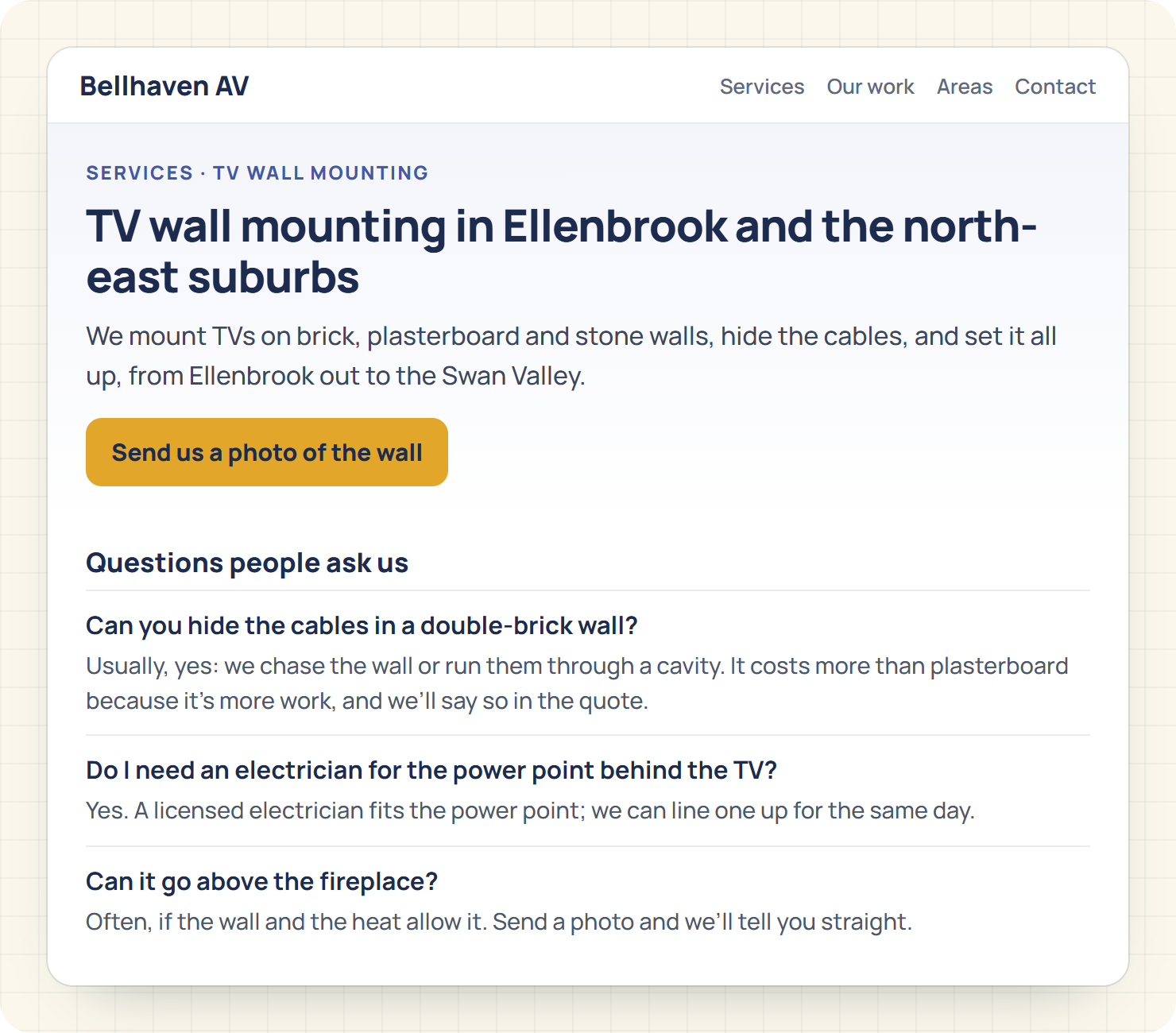
| Title | Is this the right page? | TV wall mounting in Ellenbrook and the north-east suburbs |
| Opening two lines | Do you do my job, near me? | We mount TVs on brick, plasterboard and stone walls, hide the cables, and set it all up, from Ellenbrook out to the Swan Valley. |
| How it goes | What happens, in order? | Photo of the wall, quote, booking, install, a run-through before we leave |
| Real questions | The phone list | Cables in brick, power points, above the fireplace, existing gear |
| Recent jobs | Have you done one like mine? | Three case studies with photos and captions |
| Where we go | Do you come to me? | The suburbs he actually drives to |
| Next step | What do I do now? | "Send us a photo of the wall" |
How should you answer each question?
Straight, specific and true. Three rules cover it.
Give the real answer, including "it depends". "Can you hide the cables in a double-brick wall?" The honest answer is: usually yes, by chasing the wall or running them through a cavity, and it costs more than plasterboard because it's more work. That's a far better answer than "Yes!" followed by a surprised customer when the quote arrives.
Say what you won't do, and who will. "Do I need an electrician for the power point behind the TV?" Yes, and Arjun says so: a licensed electrician does the power point, and he can line one up or work with yours. Customers trust a business that knows where its job ends.
Use their words, not yours. Callers say "hide the cables", not "concealed cable management". They say "the room's going to be out for how long?", not "project duration". Write the way they talk and they'll know they're in the right place.
Should you put prices on the page?
It's the question owners ask most, and the honest answer is: put on what you can stand behind. Customers would rather see "what changes the price" than nothing at all.
Arjun doesn't publish a single number for wall mounting, because a plasterboard wall with a power point already in place and a double-brick wall above a fireplace are completely different jobs. What he does publish is the list of things that move the price: the wall type, hiding the cables or not, the height, the bracket, and whether there's gear to connect. Then a line: "Send us a photo of the wall and we'll give you a firm price, usually the same day."
That does two jobs. It filters out the people hunting for the cheapest bloke on Gumtree, and it tells everyone else exactly what to send. If you do have fixed-price work, like a standard TV mount on plasterboard, say so, and make sure the price on the page is the price on the invoice.
One page or several?
One page per service a customer would search for on its own. "TV wall mounting", "outdoor speakers" and "meeting rooms" are three different people with three different sets of questions, so Arjun gave each its own page.
But don't slice it thinner than customers do. A separate page for "TV mounting on brick" and another for "TV mounting on plasterboard" just makes people read the same thing twice. Answer the wall question on the one page, in its own paragraph, and move on.
The test is the phone list. If two services share most of their questions, they share a page. If they share almost none, they get their own.
Which claims need proof?
Every promise on the page. Response times, "no mess", "same-week installs", qualifications, the lot. The ACCC is clear that what a business says about itself must not be false or misleading,2 and a service page is exactly that.
The simple test: for every claim, could you show a customer the evidence tomorrow? "Most installs done in a morning" needs to be true on your busy weeks, not just your quiet ones. If you can't back it, narrow it. "This lounge in Aveley took three hours, including the soundbar" is specific, provable and more convincing anyway.
What should the photos do?
Explain the work. A close-up of a cable plate sitting flush on a rendered wall says more than a wide shot of a lounge room with a TV somewhere in it.
Google's image guidance says pictures are understood through the text around them and their descriptions.3 So caption every photo with what the reader is actually looking at: "Cables chased into a double-brick wall in Brabham, 65-inch TV, soundbar on a bracket below." That caption answers question one and question five before anyone picks up the phone.
Arjun now photographs every finished install before he packs up, the same way: wide, close-up of the cables, close-up of the bracket. It takes two minutes and it's the most valuable two minutes of his day for marketing.
How do you write the title and the snippet?
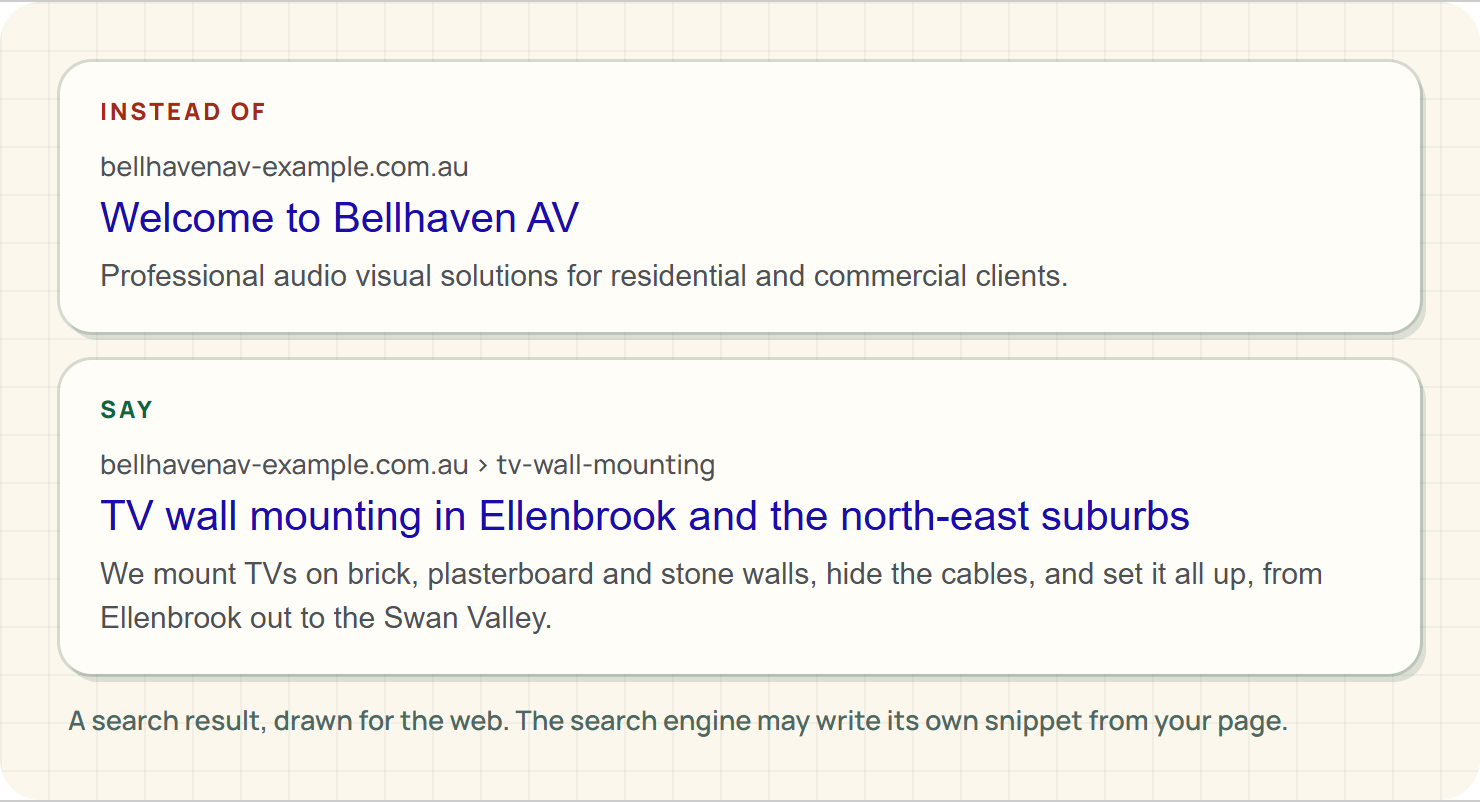
Plainly. Google says title links work best when the page title clearly describes the page,4 and it may write the search snippet from your page content or use the description you give it.5 Either way, the words have to match what's on the page.
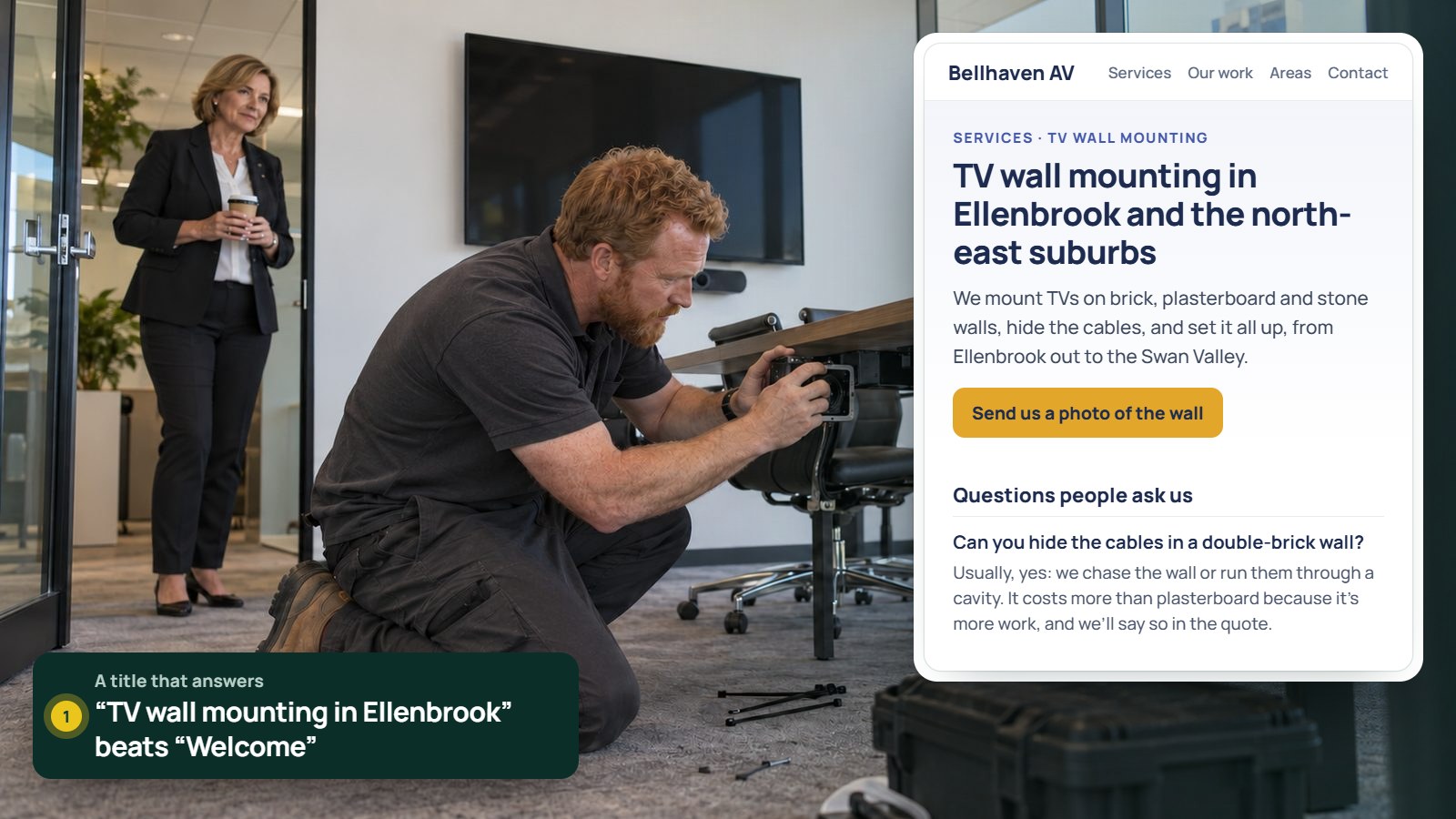
"TV wall mounting in Ellenbrook and the north-east suburbs" beats "Welcome to Bellhaven AV" every day of the week. Nobody has ever searched for "welcome".
What's the next step on the page?
One clear action that matches how you really quote. For Arjun, a photo of the wall saves a site visit most of the time, so the button says "Send us a photo of the wall", and the form asks for the suburb, the TV size and a description.
W3C's forms guidance says labels and instructions should be clear.6 The same goes for the button that leads to the form. "Send us a photo of the wall" tells people what to have ready. "Submit" tells them nothing.
Where EasyDone Studio comes in
Yeah, we make EasyDone Studio, so we're biased. Here's why we reckon it suits this job.
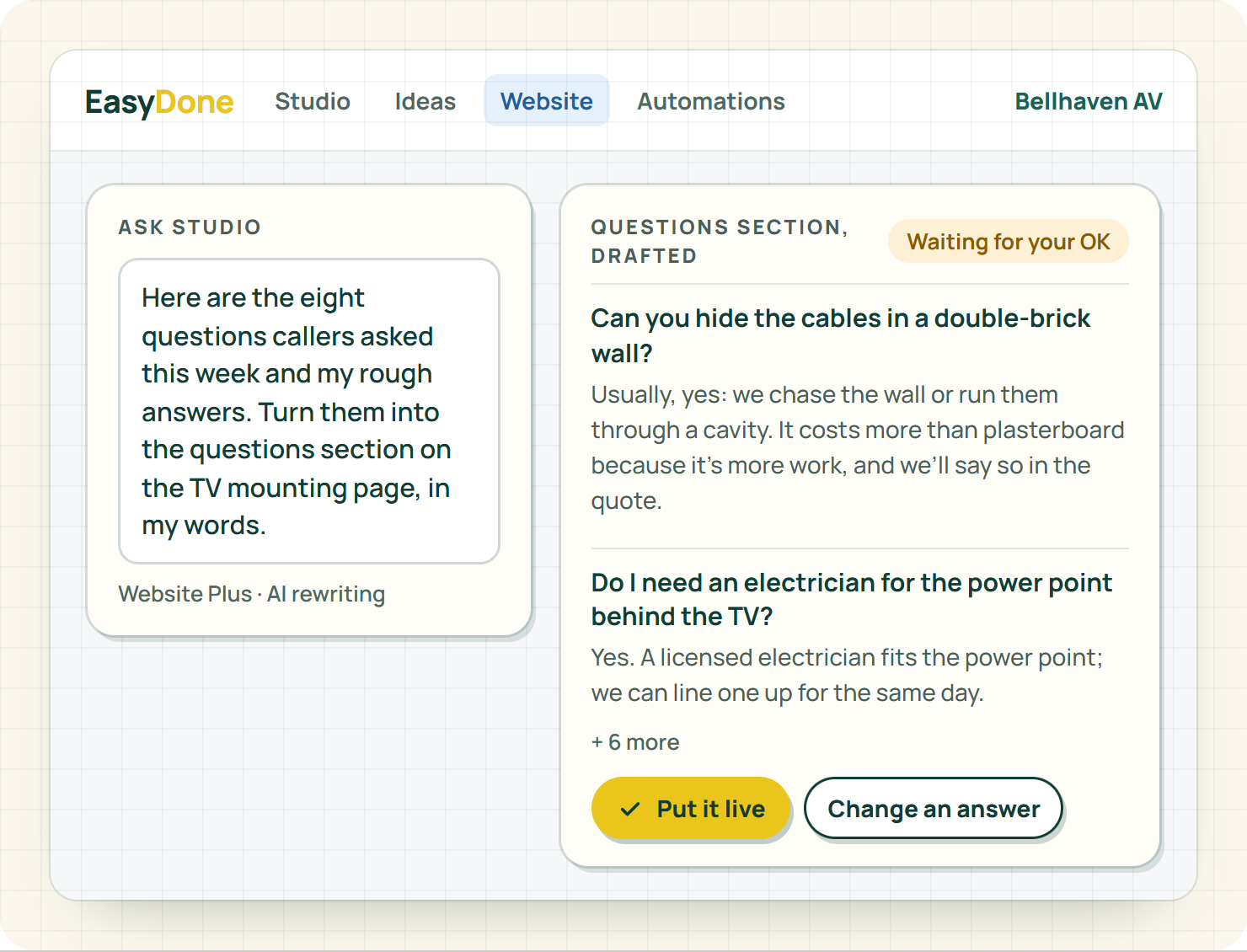
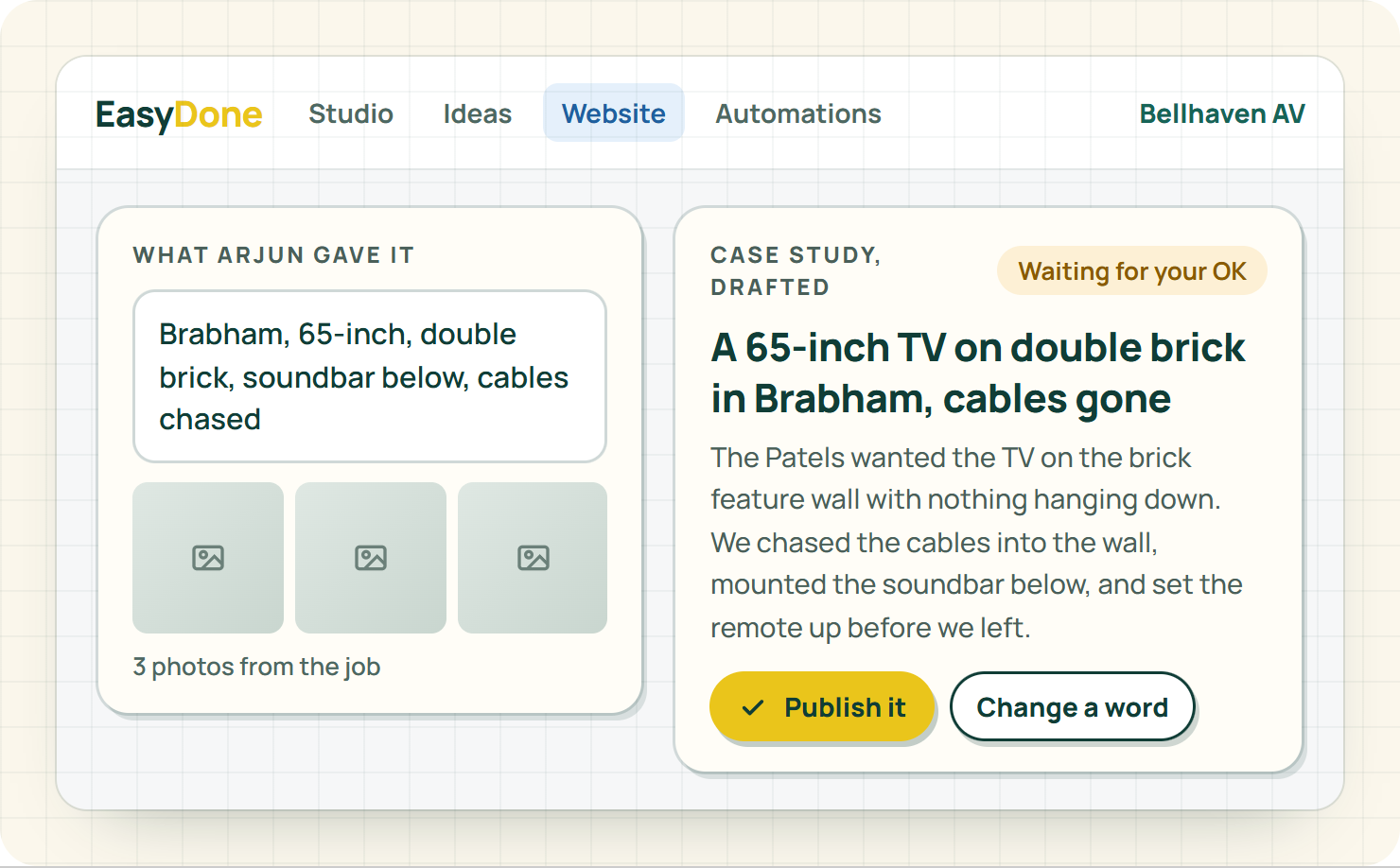
Website Plus adds AI writing for pages and case studies, AI rewriting of what's already on your site, and AI ideas for your site and content.7 Arjun handed it his eight questions and his rough answers, scribbled between jobs, and got back a page that reads like him explaining it at the door. He fixed two answers, and it went live.
The case studies are where it really pays off. "Brabham, 65-inch, double brick, soundbar below, cables chased" plus three photos becomes a proper write-up without Arjun sitting down to write it.7
Growth adds competitor research for search and Agent Optimisation, so AI assistants understand what you do and where.7 That's handy for spotting the questions other AV businesses in the north-east are answering that you aren't, and making sure an AI assistant asked about TV mounting near Ellenbrook has your details straight.
One honest limit: Studio can write the answers, but only you know them. Give it the phone list, not a blank page.
What's in each plan is on the pricing page.
So how did Arjun go?
Three months in, the "do you do..." calls have mostly stopped. The calls he gets now start with "I saw you can hide the cables in brick, I've got a wall in Aveley..." and come with a photo already sent.
The meeting room page answers "how long will we lose the room?" in the second paragraph, and an office manager in Malaga booked from it without ringing at all. She said it was the only AV website that told her.
Your turn
Put a notepad in the ute this week. Write down every question a caller asks before they book. On Friday, pick your most important service and answer those questions on its page, in their words. Our guide to business details that match helps with the facts around it.
And if you'd rather not write it yourself, see what EasyDone Studio builds for your business: your services, your suburbs, your questions, answered.
Sources
- developers.google.com: Google: Helpful, reliable content accessed Saturday 10 October 2026
- accc.gov.au: ACCC: False or misleading claims accessed Saturday 10 October 2026
- developers.google.com: Google: Image search guidance accessed Saturday 10 October 2026
- developers.google.com: Google: Title links accessed Saturday 10 October 2026
- developers.google.com: Google: Search snippets accessed Saturday 10 October 2026
- w3.org: W3C: Accessible forms accessed Saturday 10 October 2026
- Product documentation: EasyDone Studio: Plan inclusions accessed Saturday 10 October 2026
Researched and written with AI for EasyDone Studio. Every figure links to the source it came from.