
Written by the EasyDone team. Last checked 10 October 2026.
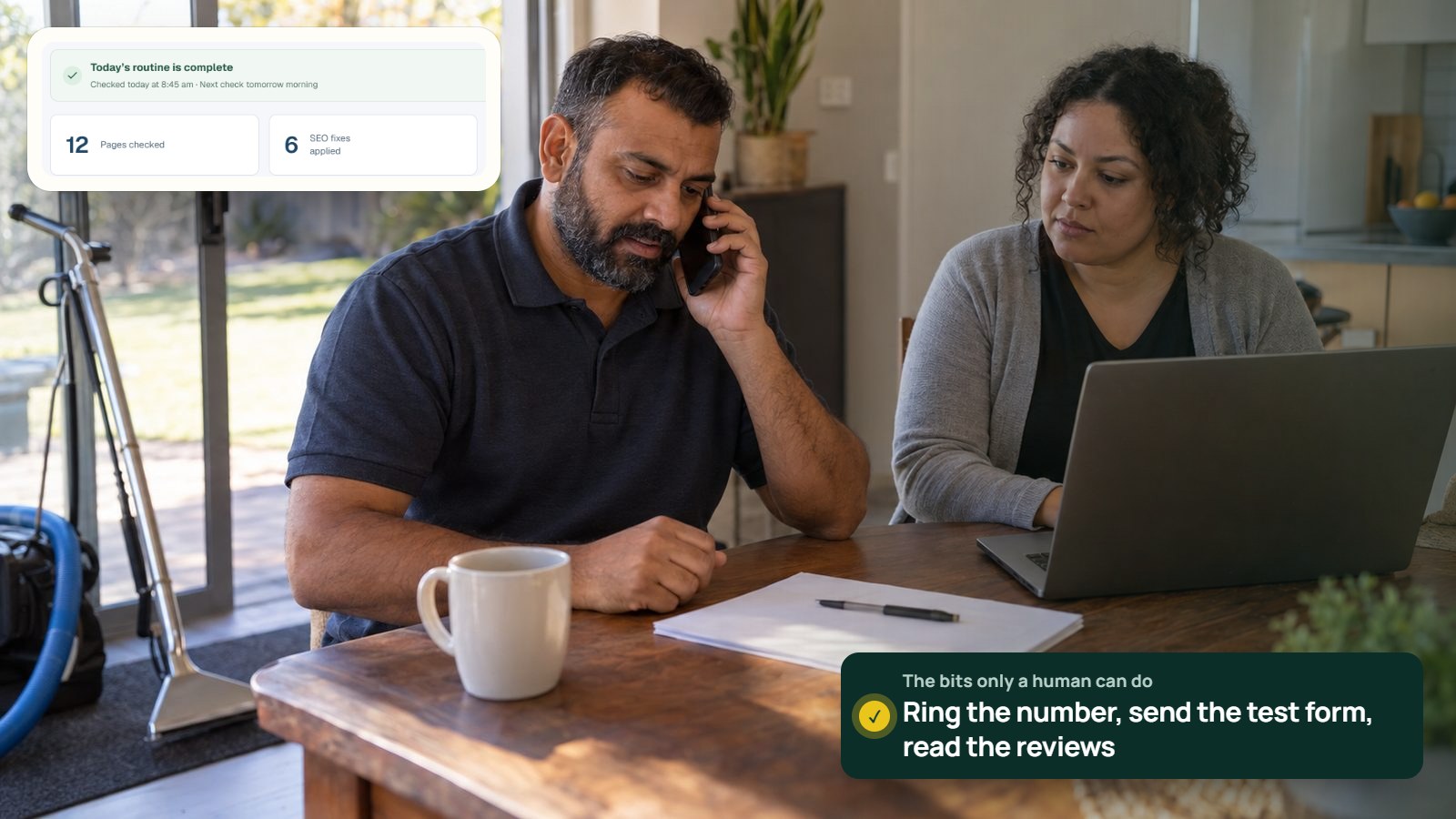
First Monday of the month, 7 am, a kitchen table in Baldivis. Dean Marchetti has a long black, Sue has the laptop and a biro, and the van's already loaded for an end-of-lease job in Secret Harbour. They've got half an hour before he leaves.
Dean picks up his phone, Googles his own business, Coastal Fresh Carpet Care, and rings the number on the listing. His other phone rings on the bench. Sue ticks the first box.
They didn't always do this. They started after the month the quote form on the website quietly sent every enquiry to an old inbox nobody had opened since the previous office manager left. Three weeks of end-of-lease jobs, sitting there going cold, while Dean wondered why the phone had gone so quiet in peak season.
That's what a monthly local search check is really for. Not a fat report. Not a dashboard with forty charts. A half-hour routine that catches the stuff quietly costing you work. Here's Dean and Sue's, step by step.
What do you grab before you sit down?
Four things: your Google listing, the two or three service pages that bring in the money, your Search Console, and a quick tally from whoever answers the phone. Not every page on the site. The ones that pay the bills.
Sue's tally is the gold. How many calls and forms came in, and what did people get wrong? Did someone in Joondalup expect Dean to drive an hour north for one lounge room? Did someone ask for upholstery, which he gave up two years ago? Those are your clues.
Google says accurate business information is part of the foundation for showing up locally.1 So fix the facts first, before anyone starts dreaming up clever new content.
And keep last month's list beside you. If the same problem turns up three months running, stop admiring it and work out what's stopping the fix.
What do you check first?
Anything that sends a customer down the wrong path. A broken phone link, a form that doesn't arrive, wrong hours, a service you don't do any more.
Open the website on your phone like a customer would and do the main thing it asks: press the call button, fill in the quote form. Sue sends a form every month marked "TEST, Dean, ignore", then checks two things: did the customer see a sensible thank-you, and did it actually land in the inbox they check?
Google wants your name, phone and location to match the real business.2 Check that the listing and the website still agree, especially after you've moved, changed numbers or changed who answers the phone.
Write every problem down in plain words. "The quote button on the end-of-lease page rings the old number" is a job someone can fix by lunch. "Improve digital presence" is a slogan and another meeting.
Are your service pages pulling their weight?
Pick one or two pages a month and read them out loud, like a customer who's never cleaned a carpet in their life. Does the page say what you do, where you go, what it costs roughly or how to find out, and what happens next?
Look for what's changed since last time. Dean's end-of-lease page didn't mention drying time, so customers were booking him for 3 pm on the day of the final inspection. One added line ("allow four to six hours to dry, so book the day before") saved a lot of awkward phone calls.
Google's own advice is to write for the person reading, not for the search engine.3 One genuinely better page beats another vague article about "the importance of clean carpets".
If a page needs a proper rebuild, our service-page guide walks through it. Note what the problem was, so whoever checks the new version knows what fixed looks like.
Which numbers are actually worth looking at?
Just a few. In Search Console, look at your money pages and the searches that found them, and keep "people who saw you" separate from "people who clicked". Search Console reports those as two different measures, impressions and clicks.4
Compare like with like. October against September, not October against the dead week after Christmas. And remember what else changed: school holidays, a week off sick, a new van on the road. A busy month can have five causes, and only one of them is your website.
Not every visit is worth the same, either. If the page is pulling in people searching for carpet cleaning in suburbs you'll never drive to, the fix is clearer words about where you go, not more traffic.
Our Search Console guide sets up a small check you can repeat in ten minutes. The point is decisions, not charts.
What are your reviews telling you?
Read every new review this month, then check every happy customer got asked. Google lets you share your review link and ask customers for feedback.5 Ask everyone, not just the ones who smiled.
Don't chase a star number. Read for patterns. Two reviews this month said the carpet was still damp at dinner time. That's not a marketing problem, it's a heads-up Dean should give on the booking call, and it went on the action list as an operations fix, not a reply.
Keep private job details out of public replies. Say thanks, fix what needs fixing, and take anything personal offline.
Do you need to care about the techy speed scores?
Only when they explain a real customer problem. Google's Web Vitals measure how fast the page loads, how quickly it responds when you tap, and whether it jumps around while you're trying to use it.6
If the page jumps just as someone goes to press "Get a quote", that's real. Fix it. If a report hands you a red score and no explanation, ask whoever looks after the site what caused it and which repair actually matters.
Never approve a whole rebuild off a scary-looking dashboard. Ask for the affected pages, what it does to customers and the proposed fix in plain English. When it's done, try the thing that was broken again.
Where does EasyDone Studio take this off your plate?
Yeah, we make EasyDone Studio, so we're biased. Here's why we reckon it earns its place at Dean's kitchen table.
Studio's Growth plan runs ongoing website checks and SEO improvements, competitor research for search, Agent Optimisation so AI assistants can understand what you do and where, and review request workflows, all in the background while you're on the tools.7 You decide whether each piece of work just runs or waits for your OK first.
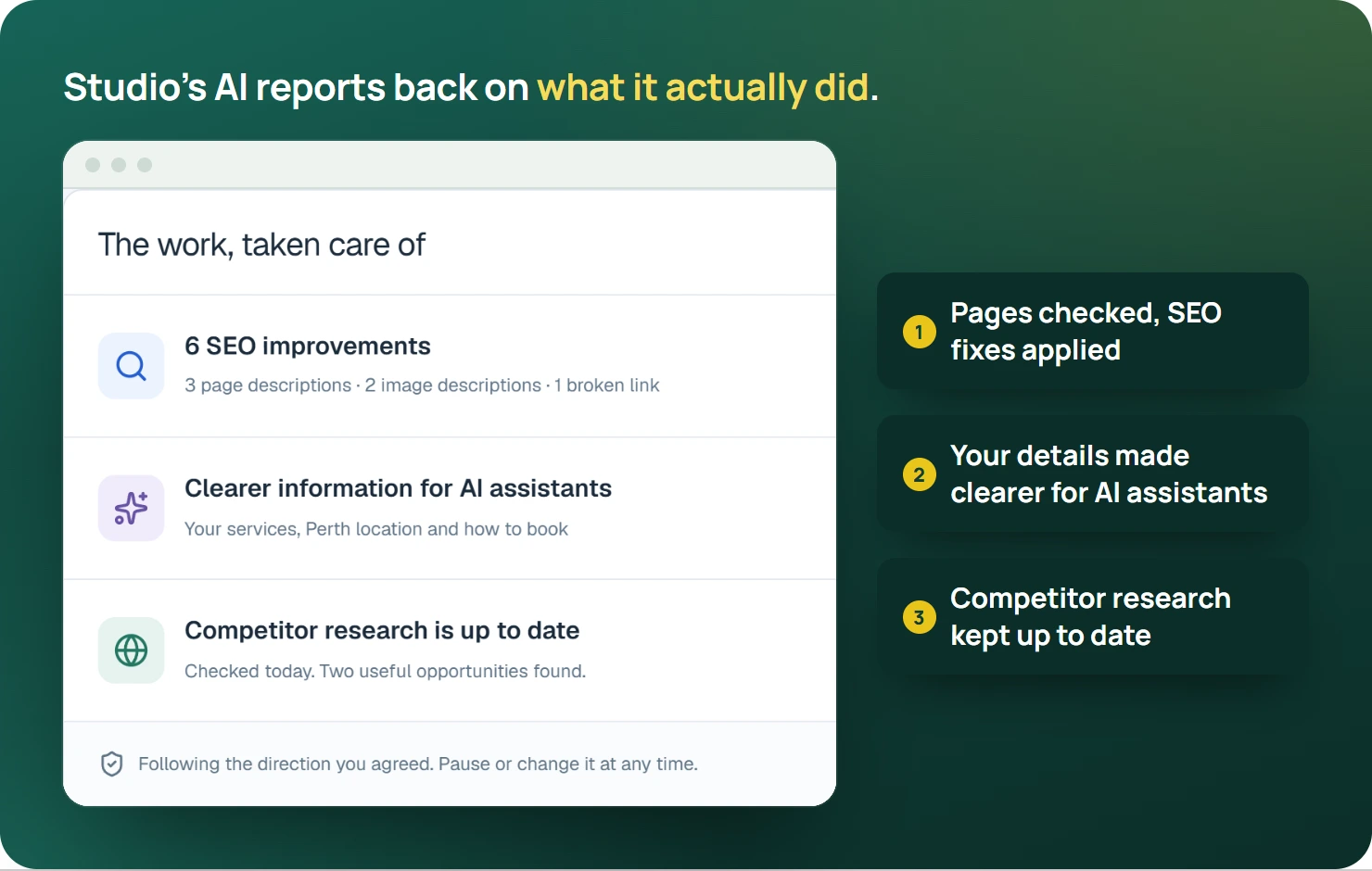
So the techy half of Dean's checklist (page titles, image descriptions, broken links, what the competition's up to) gets done for him and shows up as a list of what changed. His half-hour shrinks to the bits only a human can do: ring the number, send the test form, read the reviews and ask Sue what callers got wrong.
One honest limit: Studio makes your information clearer and keeps your site in shape, but where you rank is still Google's call.
What's in each plan is on the pricing page.
What goes on the action list?
Every line gets three things: the problem, who's fixing it, and how you'll know it's fixed. Keep the list short enough to actually finish before next month.
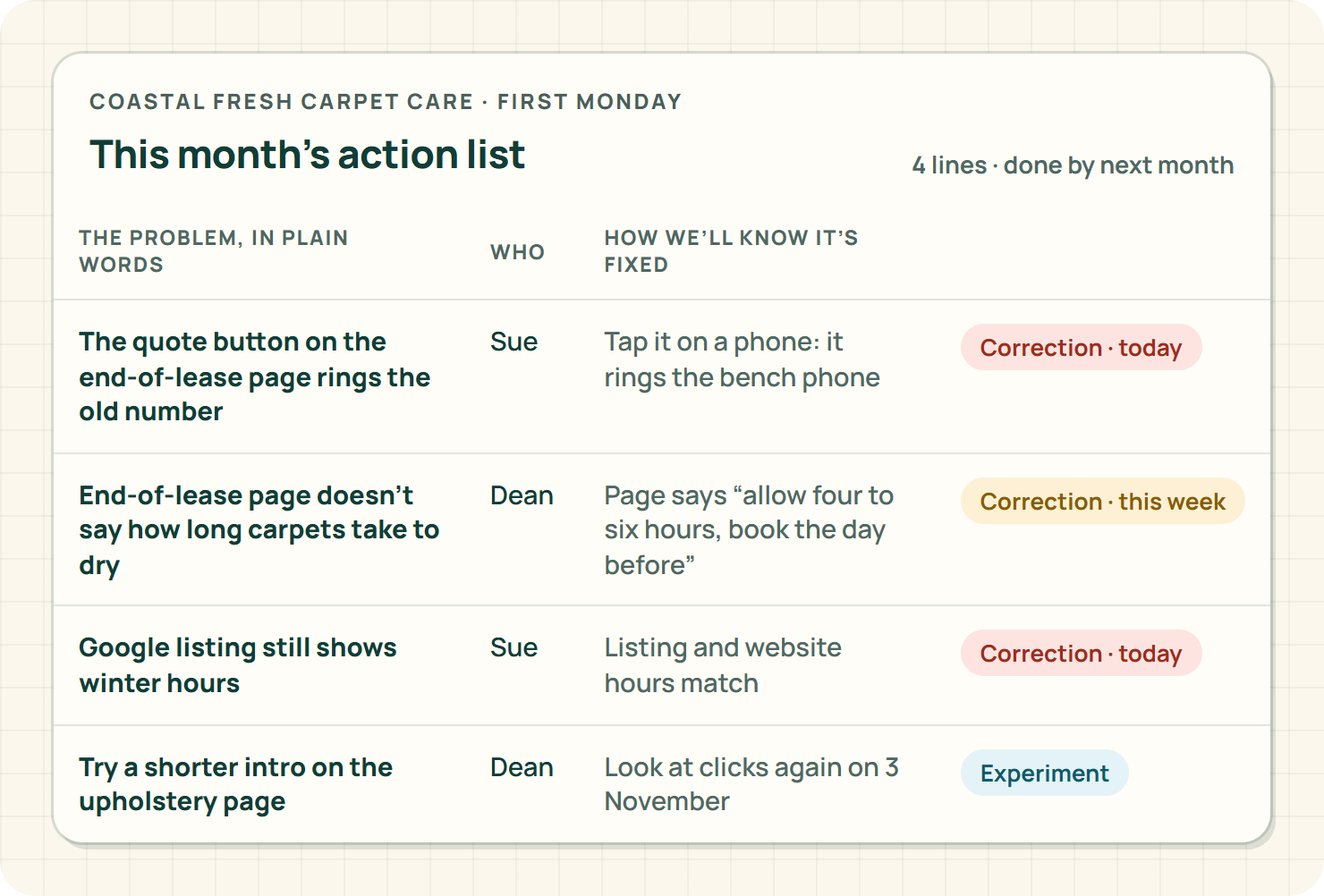
Split corrections from experiments. Fixing a wrong phone number is a correction: do it today. Trying a new intro on the end-of-lease page is an experiment: note the date and look at it again next month.
And if nothing's broken, write "all good" and go to work. Don't change a page just because the calendar says you owe it some fresh adjectives.
So how did Dean's half-hour go?
Phone rang the right phone. Test form landed in the right inbox. One line about drying time added to the end-of-lease page, one review reply sent, one note for the booking script. Sue closed the laptop at 7.32 and Dean was on the Kwinana Freeway by quarter to.
That's the whole trick. Not a big project. A small habit that finds the broken quote form in week one instead of week three.
Pick your first Monday, grab a cuppa and ring your own number. And if you'd rather the techy half was done for you, see what EasyDone Studio builds for your business.
Sources
- support.google.com: Google: Improve your local ranking accessed Saturday 10 October 2026
- support.google.com: Google: Represent your business accurately accessed Saturday 10 October 2026
- developers.google.com: Google: Helpful, reliable content accessed Saturday 10 October 2026
- support.google.com: Google: Search Console performance accessed Saturday 10 October 2026
- support.google.com: Google: Get more reviews accessed Saturday 10 October 2026
- web.dev: Google web.dev: Web Vitals accessed Saturday 10 October 2026
- Plan inclusions verified against the nominated local website CONTENT.md: EasyDone Studio: Plan inclusions accessed Saturday 10 October 2026
Researched and written with AI for EasyDone Studio. Every figure links to the source it came from.